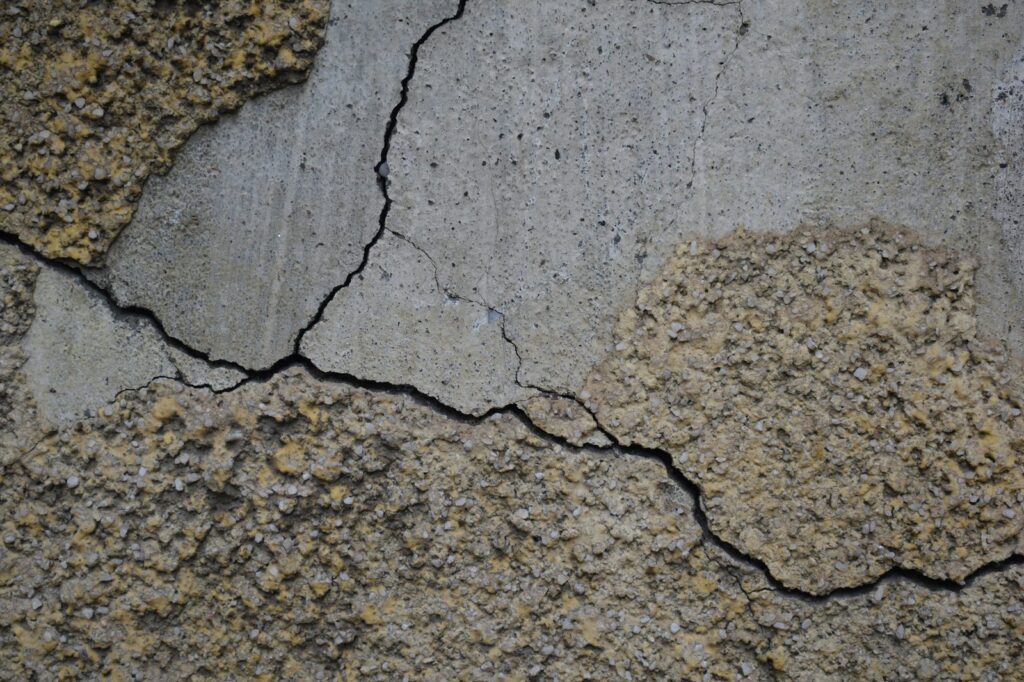
Concrete is durable, but it is not inert. It is a porous material with an alkaline pore solution, usually reinforced with steel that depends on that alkalinity to stay passive. Over years and decades, carbon dioxide, chlorides, sulfates, acids, frost and reactive aggregates can each break down the concrete or the reinforcement inside it.
Understanding which mechanism is at work matters because the repair and protection strategy depends on it. A coating that slows carbonation will do little against alkali-silica reaction, and a patch repair that ignores chlorides in the surrounding concrete may simply move the corrosion next door.
This guide explains the main deterioration mechanisms in plain terms. Diagnosing a real structure needs a condition survey by a qualified engineer, with testing to confirm the cause.
Key takeaways
- Carbonation lowers the alkalinity of the concrete cover until reinforcement can corrode.
- Chlorides from de-icing salts or seawater break down the protective film on steel even when the concrete is still alkaline.
- Freeze-thaw damage happens when saturated concrete freezes repeatedly; air entrainment is the main defence in new concrete.
- Sulfate attack and alkali-silica reaction are chemical reactions that cause expansion and cracking from within.
- Acid attack, including biogenic sulfuric acid in sewers, dissolves the cement paste itself.
- Cracks are both a symptom and an accelerator, giving water and aggressive agents a shortcut to the steel.
Why reinforcement normally does not rust
Fresh concrete has a highly alkaline pore solution, typically around pH 12.5 to 13.5. In that environment a thin, stable oxide film forms on the steel surface and keeps corrosion extremely slow. This is called passivation.
The concrete cover, the layer of concrete between the steel and the outside surface, protects that environment. Its thickness and quality (how dense and impermeable it is) largely determine how long it takes for aggressive agents to reach the steel. Two mechanisms commonly break down passivation: carbonation and chlorides.
When steel corrodes, the rust occupies several times the volume of the original metal. That expansion creates tensile stresses the concrete cannot resist, which leads to cracking, delamination and eventually spalling. Our guide to concrete spalling prevention covers that end stage in detail.
Carbonation
What happens: carbon dioxide from the air diffuses into the concrete and reacts with calcium hydroxide and other hydration products in the cement paste. This lowers the pH of the pore solution. When the carbonation front reaches the reinforcement and the pH has dropped far enough (commonly described as below about 9), the passive film is no longer stable and the steel can corrode if moisture and oxygen are present.
What speeds it up:
- Thin or porous cover, poor compaction and inadequate curing.
- Higher water-cement ratio.
- Intermediate humidity. Carbonation progresses fastest when concrete is neither saturated (which blocks gas diffusion) nor very dry (which slows the reaction). Sheltered surfaces that are not wetted by rain often carbonate faster than exposed ones, though exposed ones are wetter and so corrode faster once carbonated.
How it is measured: a phenolphthalein indicator sprayed on a fresh fracture or core turns pink on alkaline concrete and stays colorless where the concrete has carbonated. Comparing carbonation depth with cover depth from a cover meter survey shows how close the front is to the steel.
How protection interrupts it: anti-carbonation coatings (often acrylic or other film-forming coatings with high resistance to carbon dioxide diffusion) slow further carbonation while letting water vapor escape. Where the front has already reached the steel, options include patch repair of damaged areas, realkalization, corrosion inhibitors or cathodic protection, chosen by an engineer.
Chloride-induced corrosion
What happens: chloride ions from de-icing salts, seawater, salt spray or, in older structures, chloride-containing admixtures or aggregates penetrate the concrete. When the chloride concentration at the steel exceeds a threshold, the passive film breaks down locally, even though the concrete is still alkaline. The result is often pitting corrosion, which can reduce the steel cross-section significantly before much surface damage is visible.
Where it occurs: bridge decks, parking structures, marine structures, highway barriers, tunnel portals, and any element splashed or sprayed by salty water.
How it is measured: concrete samples taken at increasing depths are analyzed for chloride content to build a chloride profile. Half-cell potential mapping and resistivity measurements help identify areas where active corrosion is likely, and they are interpreted together with cover and chloride data. Our guide to chloride-induced corrosion covers thresholds, testing and treatment options in more depth.
How protection interrupts it:
- Waterproofing membranes stop chloride-laden water reaching the concrete, which is the main reason bridge decks are waterproofed; see bridge deck waterproofing.
- Hydrophobic impregnations such as silanes reduce water and chloride uptake on surfaces that cannot be fully coated.
- Crack-bridging membranes and coatings stop chlorides entering through cracks.
- Electrochemical methods such as cathodic protection or chloride extraction address chlorides already in the concrete.
Freeze-thaw damage
What happens: water expands by about 9 percent when it freezes. In saturated concrete, ice formation and the movement of water in the pore system create internal pressures. Repeated cycles cause internal cracking and surface scaling, especially where de-icing salts are used, because salt changes the freezing behavior at the surface and increases saturation.
What resists it: in new concrete, intentionally entrained air creates a network of tiny voids that relieve pressure. Low water-cement ratio, adequate strength and proper curing help. On existing structures, keeping concrete from becoming saturated is the main lever: drainage, waterproofing and breathable water-repellent treatments.
Sulfate attack
What happens: sulfates in soil, groundwater, seawater or industrial liquids react with hydrated compounds in the cement paste, forming expansive products such as ettringite and gypsum. This causes expansion, cracking and softening, often starting at surfaces and edges in contact with the sulfate source.
What resists it: concrete designed for the exposure, with suitable cement type, supplementary cementitious materials and low permeability, is the primary defence. For existing structures, below-grade waterproofing or a protective barrier can separate the concrete from sulfate-bearing water; see below-grade waterproofing.
Alkali-silica reaction (ASR)
What happens: some aggregates contain reactive forms of silica. These react with alkalis in the pore solution to form a gel that absorbs water and swells. The swelling cracks the concrete, often in a characteristic map or pattern cracking on unrestrained surfaces, sometimes with gel deposits at cracks.
What affects it: reactive aggregate, high alkali content and moisture all need to be present. Reducing moisture can slow the reaction, which is why some ASR-affected structures are treated with breathable coatings or water-repellent impregnations, but there is no simple coating cure. Assessment and management of ASR-affected structures needs specialist engineering input.
Acid and chemical attack
What happens: acids react with the alkaline cement paste, dissolving it and loosening aggregate. The rate depends on the acid type, concentration, temperature and how often the surface is renewed by flowing liquid.
Biogenic sulfuric acid: in sewers, wet wells and some treatment structures, hydrogen sulfide gas released from wastewater is converted by bacteria living on moist concrete surfaces above the water line into sulfuric acid. This can attack concrete severely, often concentrated in crowns, walls and around turbulent inflows. It is one of the main reasons wastewater structures are lined; see wastewater tank linings.
Other sources: acidic groundwater, food and beverage processing, chemical plants, agricultural buildings and soft water can also attack concrete.
How protection interrupts it: acid exposure is typically handled with chemical-resistant linings, such as suitable epoxies, polyureas, embedded plastic liners or specialized mortars, selected for the actual acid and concentration.
Cracking
Cracks are not a single mechanism but a pathway that accelerates most others. Common causes include:
| Type | Typical cause | Timing |
|---|---|---|
| Plastic shrinkage | Rapid drying of fresh concrete surface | Hours after placing |
| Plastic settlement | Concrete settling around bars or formwork | Hours after placing |
| Early thermal | Temperature drop after heat of hydration in thick sections | Days |
| Drying shrinkage | Loss of moisture over time, restrained movement | Weeks to years |
| Structural | Loads, settlement, overloading | Any time |
| Expansion from within | Corrosion, ASR, sulfate attack, freeze-thaw | Years |
Whether a crack matters depends on its width, depth, whether it moves and what it lets in. A static hairline crack in a dry interior wall is usually cosmetic; a moving crack in a salted parking deck is a direct route for chlorides to the reinforcement. Our guides to crack injection and parking deck traffic membranes cover how each case is usually treated.
Water: the common factor
Almost every mechanism needs water. Chlorides and sulfates travel in solution. Corrosion needs moisture as an electrolyte. Freeze-thaw needs saturated pores. ASR gel needs water to swell. Biogenic acid forms in moist films. That is why so much concrete protection is really moisture management: drainage, waterproofing, crack sealing and water-repellent treatments.
How protection systems map to mechanisms
| Mechanism | Main protective approaches | Notes |
|---|---|---|
| Carbonation | Anti-carbonation coatings; increased cover in repairs | Must allow vapor to escape on most structures |
| Chlorides | Waterproofing membranes, silane impregnation, crack-bridging coatings, cathodic protection | Existing chlorides need assessment before coating |
| Freeze-thaw | Drainage, water-repellent treatments, membranes | Avoid trapping moisture behind vapor-tight coatings |
| Sulfates | Barrier membranes, below-grade waterproofing | New concrete design is the primary defence |
| ASR | Moisture reduction, breathable coatings | Specialist assessment needed |
| Acids | Chemical-resistant linings | Select for actual chemical and concentration |
| Cracking | Crack repair, injection, crack-bridging membranes | Determine if cracks are moving |
The European EN 1504 series groups these approaches into principles for protection and repair, such as protection against ingress, moisture control, concrete restoration and preserving or restoring the passivity of the reinforcement. Similar guidance exists from bodies such as ACI and ICRI in North America. Our comparison of protective coating systems explains the generic coating families.
Repair first, then protect
A protective coating applied over active corrosion, delaminated concrete or high chloride levels can trap the problem rather than solve it. The usual sequence is:
- Survey and test: visual inspection, hammer sounding, cover, carbonation depth, chloride profiles, half-cell potential and other tests as needed.
- Diagnose: identify the mechanism or mechanisms and the extent of contaminated concrete.
- Repair: remove damaged and contaminated concrete, treat or replace reinforcement as an engineer directs, and reinstate with suitable repair materials.
- Protect: apply the protective system chosen for the remaining risks.
- Monitor and maintain: inspect periodically and renew coatings as they age.
Bottom line
Concrete deteriorates mainly through reinforcement corrosion caused by carbonation or chlorides, through freeze-thaw cycles, through chemical reactions such as sulfate attack and ASR, and through acid attack. Water is involved in nearly all of them, and cracks speed them up. Protective systems work by keeping water, carbon dioxide, chlorides or acids away from the concrete and steel, but only after the right mechanism has been identified and existing damage repaired. That diagnosis belongs to qualified engineers with test data, not to a product brochure.