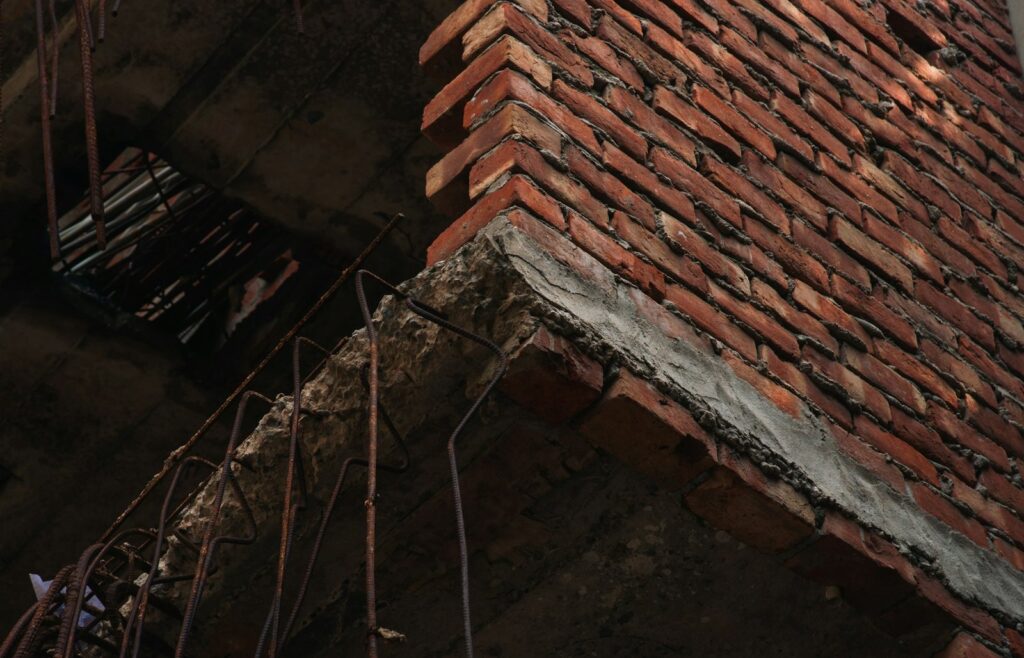
Spalling is the breaking away of pieces of concrete from a surface. On a parking garage soffit it is an expensive maintenance problem. Over a road, a railway, a sidewalk or a tunnel lane it is a public safety problem, because a fragment the size of a fist can cause serious injury or damage when it falls from height onto people or vehicles.
This guide explains why spalling happens, how owners find it before pieces fall, how damaged areas are repaired, and how anti-spalling systems are used to reduce the risk of fragments falling afterwards. It is general information for owners, managers and students. Assessment, repair design and system selection for a real structure must come from qualified engineers, using the manufacturer’s data and the standards and owner requirements that apply.
Key takeaways
- The most common cause of spalling is reinforcement corrosion, triggered by carbonation or chlorides, with rust expanding and cracking the cover.
- Delamination comes before spalling. Hammer sounding and other surveys can find hollow areas before they fall.
- Repairs have their own risks, including new corrosion around the edges of patches if surrounding concrete is contaminated.
- Anti-spalling systems use either fiber or mesh reinforcement in a resin, or a high-elongation membrane, to hold fragments in place.
- Owners should ask about adhesion, testing, inspectability, fire performance and maintenance before choosing a system.
Why concrete spalls
Corrosion of reinforcement
Steel in sound concrete is protected by the alkalinity of the surrounding pore solution. When carbonation lowers that alkalinity at the depth of the steel, or chlorides from de-icing salt or seawater reach a high enough concentration, the protective film on the steel breaks down and corrosion starts. Our guide to why concrete deteriorates explains both mechanisms.
Rust occupies several times the volume of the steel it replaces. The expansion pushes against the concrete cover, first causing fine cracks along the line of the bar, then a plane of delamination at the level of the reinforcement, and finally the loss of the cover concrete. Where bars are closely spaced or cover is thin, delaminations can join up across large areas.
Other causes
- Freeze-thaw damage, especially where saturated concrete is exposed to de-icing salts.
- Alkali-silica reaction and other internal expansion.
- Fire, which can cause explosive spalling as moisture in the concrete turns to steam.
- Impact and overload, such as vehicle strikes on bridge soffits.
- Poor construction, including low cover, honeycombing and cold joints.
- Earlier repairs that have debonded or cracked.
Where falling fragments are a hazard
The consequence of spalling depends on what is underneath. Situations that usually get the highest priority include:
| Location | Why it matters |
|---|---|
| Bridge and overpass soffits above roads or railways | Fragments fall onto moving traffic or tracks |
| Tunnel linings and portals | Traffic below, limited space to close lanes, ventilation and drainage nearby |
| Parking structures | Pedestrians and vehicles below, de-icing salts carried in on cars |
| Building facades, balconies and canopies | Pedestrians and entrances below |
| Underpasses and pedestrian bridges | People below at close range |
Many road and rail authorities run inspection programs that specifically look for delaminated concrete in these locations and require urgent removal of loose material.
Inspection: finding damage before it falls
Visual inspection
Inspectors look for cracks running parallel to reinforcement, rust staining, efflorescence and leaching, bulging surfaces, previous patches, exposed bars and wet areas. Visual inspection identifies where to look more closely but cannot find delaminations that have not yet cracked the surface.
Hammer sounding and chain dragging
Tapping the surface with a hammer, or dragging chains across decks, reveals hollow-sounding areas where the cover has separated from the concrete below. It is simple and effective, though results depend on the inspector and background noise. On soffits, sounding is often combined with removing any loose material found, under controlled conditions.
Testing to understand the cause and extent
- Cover meter surveys to measure the depth of reinforcement.
- Carbonation depth using a phenolphthalein indicator on fresh fractures or cores.
- Chloride profiles from samples taken at several depths.
- Half-cell potential mapping to indicate where corrosion is likely active, interpreted with other data.
- Ground-penetrating radar, infrared thermography and impact-echo for larger surveys, depending on the structure and the access available.
- Cores and breakouts to see the condition of the steel directly.
The results let an engineer decide how much concrete needs to be removed, whether reinforcement has lost section, and what protection makes sense afterwards. Our guide to concrete condition surveys explains what each of these tests can and cannot show.
The repair-then-protect sequence
1. Make safe
Remove loose concrete where it can fall, or install temporary protection such as netting, shields or exclusion zones. This is a safety step, not a repair.
2. Break out damaged concrete
Concrete is removed from around corroding reinforcement, typically to sound concrete behind the bars, so the steel can be cleaned on all sides and the repair material can lock around it. Removal methods include hand-held breakers and hydrodemolition, chosen to avoid damaging the remaining concrete. Edges are usually cut square or slightly undercut rather than feathered, because thin feathered edges of repair material tend to break off.
3. Treat the reinforcement
Corrosion products are removed from the steel, typically by abrasive blasting or wire brushing to a specified level. Where bars have lost significant section, an engineer decides whether to add supplementary bars. Bar primers or coatings are used where the repair system calls for them.
4. Reinstate the concrete
Repair materials include cementitious repair mortars, polymer-modified mortars and sprayed concrete, chosen for thickness, orientation (overhead work needs materials that do not slump), compatibility with the parent concrete and the required strength and durability. In Europe, EN 1504 covers requirements for repair products; North American practice draws on guidance from ICRI and ACI. Our guide to choosing concrete repair mortars compares the main types in more detail.
5. Address the risk of new corrosion around patches
When a corroding area is repaired, the steel inside the patch becomes passive again, but the steel just outside it may be in chloride-contaminated concrete that was not removed. The electrochemical balance changes, and corrosion can accelerate in the surrounding concrete. This is often called the incipient anode or ring anode effect. Approaches to managing it include removing more contaminated concrete, embedded galvanic anodes in repair edges, impressed current cathodic protection and protective coatings that reduce moisture and chloride ingress. The choice is an engineering decision.
6. Protect
Once the structure is sound, a protective system reduces further deterioration and, in anti-spalling systems, holds any future fragments in place.
Anti-spalling systems
Anti-spalling systems are surface-applied systems designed so that if a piece of concrete does crack loose, it stays attached to the structure rather than falling. They are commonly considered for soffits, tunnel linings and other overhead surfaces. There are two broad approaches.
Fiber or mesh reinforced systems
A resin, often epoxy, polyurethane or acrylic, is applied together with a reinforcing fabric or mesh made from materials such as glass, aramid, carbon or polymer fibers. The mesh provides tensile strength across cracks, and the resin bonds it to the concrete.
- Strengths: high strength at low thickness; long track record in many countries.
- Considerations: multiple steps (primer, resin, mesh, saturating coat, topcoat) make application slower; laps and edges must be detailed; many systems are rigid, so moving cracks can reflect through; opaque mesh and coatings hide the surface.
High-elongation membranes
A thick elastomeric membrane, typically spray-applied polyurethane or polyurea, is applied without separate fiber reinforcement. It relies on high elongation, tear strength and adhesion so that a loosening fragment stretches the membrane rather than tearing through it. Our guide what is polyurea explains the material family.
- Strengths: continuous film without laps, fast to apply with spray equipment, bridges moving cracks, also acts as a barrier against water, chlorides and carbon dioxide.
- Considerations: thickness control is critical because performance depends on it; surface preparation and primers are demanding; spray equipment and trained crews are needed; overspray control near traffic.
Comparing approaches
| Factor | Fiber or mesh reinforced | High-elongation membrane |
|---|---|---|
| How it holds fragments | Tensile strength of mesh bonded by resin | Elongation and toughness of a thick elastomer |
| Crack bridging | Usually limited for moving cracks | Generally high |
| Barrier to water and chlorides | Depends on resin and topcoat | Typically good if continuous and pinhole-free |
| Application | Multi-step, often hand-applied | Spray-applied in fewer steps |
| Critical quality factors | Mesh laps, saturation, adhesion | Film thickness, adhesion, continuity |
Performance of anti-spalling systems is usually verified by tests that measure how much load the system can carry before a simulated loose piece of concrete pushes through, together with adhesion testing. Some highway and tunnel authorities have their own test methods and approval requirements. Ask what tests the system has passed, under which method, and how results relate to the thickness and preparation proposed for your project.
Inspectability after protection
One of the most important questions is often overlooked: how will the structure be inspected afterwards? Opaque coatings and membranes cover the cracks, rust stains and leaching that inspectors rely on. Options include translucent or lighter-colored systems where available, leaving inspection windows, embedding corrosion monitoring sensors, recording detailed condition data before coating, and agreeing a post-coating inspection method with the owner’s inspectors. Sounding through some membranes is less reliable than on bare concrete.
Other considerations
- Fire performance: tunnels and enclosed structures may have requirements for reaction to fire and smoke production.
- Vapor permeability: trapping moisture behind a vapor-tight membrane on a wet structure can cause blistering or debonding; drainage and moisture paths need thought.
- Temperature during application: cold soffits, condensation and dew point limits can restrict working windows, especially at night.
- Access and traffic management: often the largest cost on bridges and tunnels.
- Maintenance: how is the system repaired if damaged, and what is its expected maintenance interval according to the manufacturer?
Questions owners should ask
- What caused the spalling, and is that confirmed by testing?
- How much contaminated or carbonated concrete will be removed, and why that amount?
- How will the risk of new corrosion around patch repairs be managed?
- Which anti-spalling approach is proposed, and what test results support it at the proposed thickness?
- What surface preparation, primer and moisture limits does the manufacturer require?
- How will thickness and adhesion be verified on site?
- How will we inspect the structure after it is coated?
- Does the system meet fire, environmental and owner-specific requirements?
Bottom line
Spalling is usually the visible end of reinforcement corrosion, and over roads, railways and walkways it is a falling-object hazard. Find delamination early through inspection and sounding, make the area safe, diagnose the cause with testing, repair to sound concrete with attention to the steel and the surrounding contamination, and only then apply protection. Anti-spalling systems, whether mesh-reinforced or high-elongation membranes, can reduce the risk of fragments falling, but they must be selected, specified and inspected by qualified engineers using tested systems and the manufacturer’s requirements.