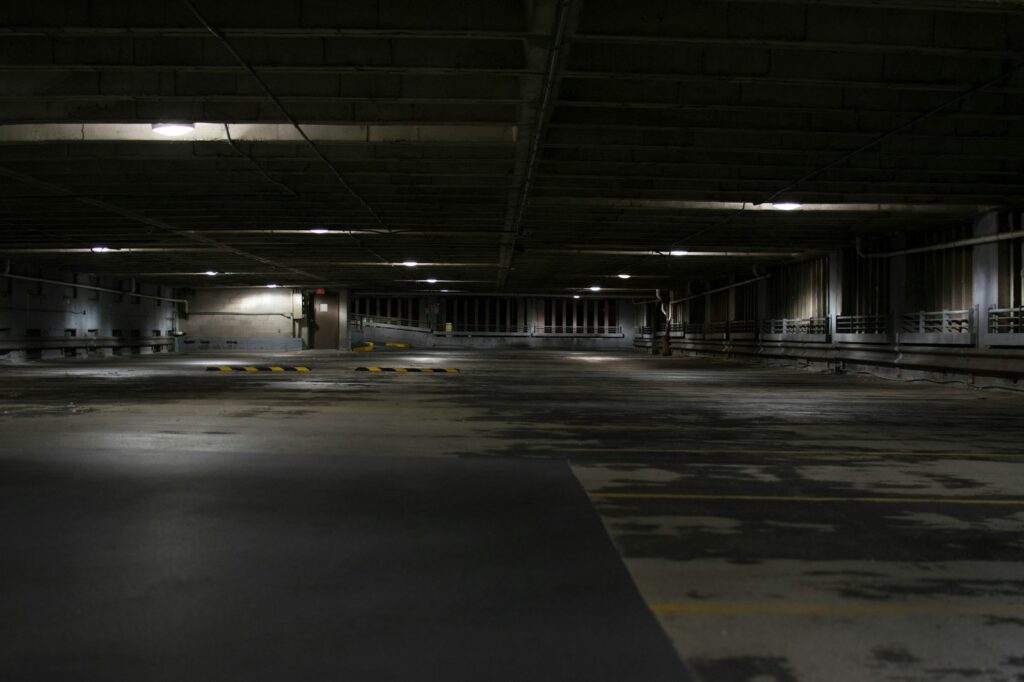
A parking structure is exposed to more water and salt than most buildings. Cars carry rain, snow and de-icing salts in from the street and drop them on every level, not only the roof. The water collects at low spots, runs to joints and cracks, and carries chlorides into the concrete slab. Many parking decks have no asphalt or tiles on top, so whatever protects the concrete must also take the tires, the turning, the snow ploughs and the cleaning machines directly.
Traffic membranes, also called traffic coatings or deck coatings, are the usual answer. This guide explains what they are, how the layers work, where they fail and how owners keep them in service. It is general information. The system for a real structure should be chosen and specified by qualified engineers, using the manufacturer’s data sheets, the results of a condition survey and the standards and codes that apply locally.
Key takeaways
- Chlorides from vehicles reach every level of a parking structure, not only the exposed roof deck.
- A traffic membrane combines waterproofing and a wearing surface in one bonded system, usually with aggregate for grip.
- Crack bridging comes from an elastomeric base layer; rigid coatings alone usually crack with the slab.
- Wear concentrates at entrances, ramps, turning areas and pay stations, so those zones often get a heavier build-up.
- Joints and drains need their own details and are where most leaks begin.
- Inspection and topcoat renewal on a planned cycle extend the life of the waterproofing layer.
Why parking decks need protection
Reinforced concrete in a parking deck usually fails by corrosion. Salt water soaks into the slab, chlorides reach the reinforcement, and the steel corrodes and expands, cracking and delaminating the concrete above it. On the underside, this shows as rust stains, cracks and spalls over parked cars and walkways. Our guide to chloride-induced corrosion explains the mechanism, and spalls over parking bays are also a falling-fragment hazard.
Post-tensioned slabs, common in parking structures, add another concern. Tendons are sensitive to corrosion, and water entering at cracks or anchorages can reach them. Keeping water off the top surface is one of the main ways designers protect them.
A membrane does not replace good concrete, adequate cover and drainage. It adds a barrier on top. Guidance on durable parking structures, such as ACI 362.1R in North America, discusses membranes alongside concrete quality, cover, drainage and slopes.
How a traffic membrane is built up
Most systems are applied as liquids that cure in place. The exact layers and thicknesses come from the manufacturer; the table shows a common arrangement.
| Layer | Function | Notes |
|---|---|---|
| Primer | Seals the concrete, improves adhesion, reduces outgassing | Chosen for the substrate and its moisture condition |
| Detail coat and crack treatment | Reinforces cracks, joints, corners and upstands before the main coat | Often includes a reinforcing fabric or extra thickness |
| Base or waterproofing coat | Elastomeric layer that bridges cracks and keeps water out | Usually polyurethane or polyurea; flexible over a temperature range |
| Wear coat with aggregate | Resists abrasion and provides grip | Aggregate is broadcast into the wet coat or mixed in |
| Topcoat | Locks in the aggregate, adds UV and wear resistance, sets the color | Aliphatic resins are often used where sunlight or color stability matters |
Some systems use a rigid wearing layer, such as an epoxy or methyl methacrylate (MMA) with aggregate, over a flexible membrane. Others are rigid coatings with no elastomeric layer, which are better described as wearing or sealing coats than as waterproofing, because they are unlikely to bridge cracks that move.
ASTM C957 is a specification for high-solids, cold liquid-applied elastomeric waterproofing membranes with an integral wearing surface, and in Europe surface protection products for concrete are covered by EN 1504-2. Many owners and authorities also set their own requirements. Check which standard or approval the project actually calls for.
Common chemistries
| Family | Strengths | Considerations |
|---|---|---|
| Polyurethane (single or two component) | Long track record, good elongation, can be applied by roller or squeegee | Some types are moisture sensitive during cure; aromatic grades yellow and chalk in sunlight |
| Polyurea and hybrids | Very fast cure, short closures, good elongation | Needs plural-component spray rigs and trained crews; fast set leaves little time for detail work |
| MMA | Cures quickly even in cold weather, useful for phased work | Strong odor during application; ventilation and occupancy planning needed |
| Epoxy (as wear or sealing coat) | Hard, abrasion resistant, good bond | Rigid; does not bridge moving cracks on its own |
For background on the spray elastomers see what is polyurea. On roof decks in sunlight, the choice of topcoat affects color and chalking, because aromatic resins yellow and chalk while aliphatic topcoats hold color better.
Crack bridging
Concrete slabs crack from shrinkage, temperature change and loading. In parking decks many cracks open and close each day and each season. A membrane bridges a crack only if its elastomeric layer can stretch over the gap without tearing and without losing bond far beyond the crack.
Points to understand:
- Static vs moving cracks. A static crack can be filled and coated. A crack that moves needs a flexible layer and often a detail strip, and wide or active cracks may need treatment as a joint.
- Temperature matters. Elastomers stiffen in cold weather, and cracks are often widest then. Data sheets usually state elongation or crack-bridging results at specific temperatures; check that the test conditions resemble the site.
- Thickness matters. Crack bridging depends on having enough film over the crack. Thin spots fail first.
- Structural cracks need an engineer’s assessment before coating. Coating over a crack does not repair it; see crack injection for when cracks are bonded or sealed.
Wear and slip resistance
The wearing surface takes abrasion from tires, studded tires where allowed, snow ploughs, and the scuffing of pedestrians. Wear is uneven. Entrances, ramps, turning areas, the space in front of barriers and pay stations, and drive aisles wear much faster than parking stalls.
Common approaches:
- Zoned build-ups. Heavier aggregate and an extra wear coat in high-traffic zones; lighter build-up in stalls.
- Aggregate type and size. Harder, angular aggregates resist polishing; the grade and broadcast rate set the texture.
- Slip resistance. Ramps and pedestrian routes need a texture that remains grippy when wet. Pendulum testing is one common method of measuring slip resistance on site; the required value comes from local regulations and the owner’s specification.
- Balance with cleaning. Very coarse textures grip well but trap dirt and are harder to clean and to plough.
Joints, drains and edges
Most leaks begin at details.
| Detail | Typical approach |
|---|---|
| Construction joints and control joints | Sealant in a prepared joint, then a detail strip of membrane over it; some designs treat them as moving joints |
| Expansion joints | Dedicated joint systems; the membrane terminates at or connects to the joint, following both manufacturers’ details |
| Drains | Membrane carried into the drain body or clamped under the drain flange so water leaves the slab |
| Curbs, walls and columns | Membrane carried up the vertical face as a cove, with a sealed termination |
| Slab edges and soffits at drip edges | Membrane turned down or terminated with a drip to stop water tracking under the slab |
| Penetrations and fixings | Barrier posts, signs and lighting fixed through the membrane need sealed details |
Ponding is a warning sign. Water that stands on a deck for long periods soaks through any small defect and keeps the surface wet. Correcting slopes or adding drains during a recoating project often does more for durability than a thicker membrane. Our guide to waterproofing details covers joints, penetrations and terminations in more depth.
Preparation and application conditions
Traffic membranes are thin compared with the slab, and their bond depends on the surface underneath.
- Repairs first. Delaminated and spalled concrete is removed and repaired before coating, with materials the membrane manufacturer accepts; see choosing concrete repair mortars. A condition survey with sounding, cover and chloride testing identifies these areas.
- Surface profile. Shot blasting is common on decks; the manufacturer usually states the required profile on the ICRI CSP scale. See concrete surface preparation.
- Contamination. Oil, rubber and salt deposits must be removed. Salt left on the surface can cause blistering later.
- Moisture and temperature. Substrate moisture, surface temperature above dew point and the temperature trend during cure all affect results. Typical ranges are given in the data sheet.
- Outgassing. Applying primers while the slab is warming can produce pinholes. Many crews prime when slab temperature is steady or falling.
Thickness of each layer is checked with wet film gauges, material usage per area, and in some cases destructive or ultrasonic measurement, as the specification requires. Pull-off adhesion tests confirm bond.
Working in an occupied structure
Most recoating work happens while the rest of the structure stays open. Planning covers phasing by level or bay, temporary traffic routes, odor and fumes from some resins, ventilation in enclosed levels, overspray protection for parked cars, and the time before each zone can take foot and vehicle traffic. Return-to-service times vary widely by chemistry and temperature; check the manufacturer’s data sheet rather than assuming.
Maintenance cycle
A traffic membrane is a wearing surface, so it is expected to need maintenance. A typical owner program includes:
- Regular cleaning, especially after winter, to remove salt, grit and debris that act as abrasives and hold water on the surface.
- Periodic visual inspection of wear zones, joints, drains, curbs and terminations, with photos for comparison.
- Prompt local repair of cuts, tears and debonded areas before water gets under the membrane.
- Topcoat renewal in worn zones, done while the waterproofing layer below is still intact. The interval depends on traffic, climate and system; the manufacturer usually gives guidance.
- Joint sealant replacement as sealants harden or debond.
Renewing topcoats is far cheaper than replacing a whole system after the base coat has worn through and water has reached the slab. Recoating over an existing membrane requires confirming compatibility and adhesion with the manufacturer, often with a test area.
Questions for owners to ask
- Has a condition survey been done, and are repairs and crack treatment included in the scope?
- Which zones get a heavier wear build-up?
- What crack-bridging performance is claimed, at what temperature and thickness?
- How will joints, drains, curbs and edges be detailed?
- What tests and records will be provided, and at which hold points?
- What maintenance does the manufacturer expect, and how often?
Bottom line
Parking decks carry salt to every level, and the slab can only be protected by a layer that both keeps water out and survives traffic. Traffic membranes do this with an elastomeric base for crack bridging and a wearing layer with aggregate for abrasion and grip. They work when the slab is repaired and prepared first, when joints, drains and edges are detailed properly, and when the owner cleans, inspects and renews topcoats before wear reaches the waterproofing layer. Let qualified engineers specify the system, follow the manufacturer’s data sheet and treat maintenance as part of the design.