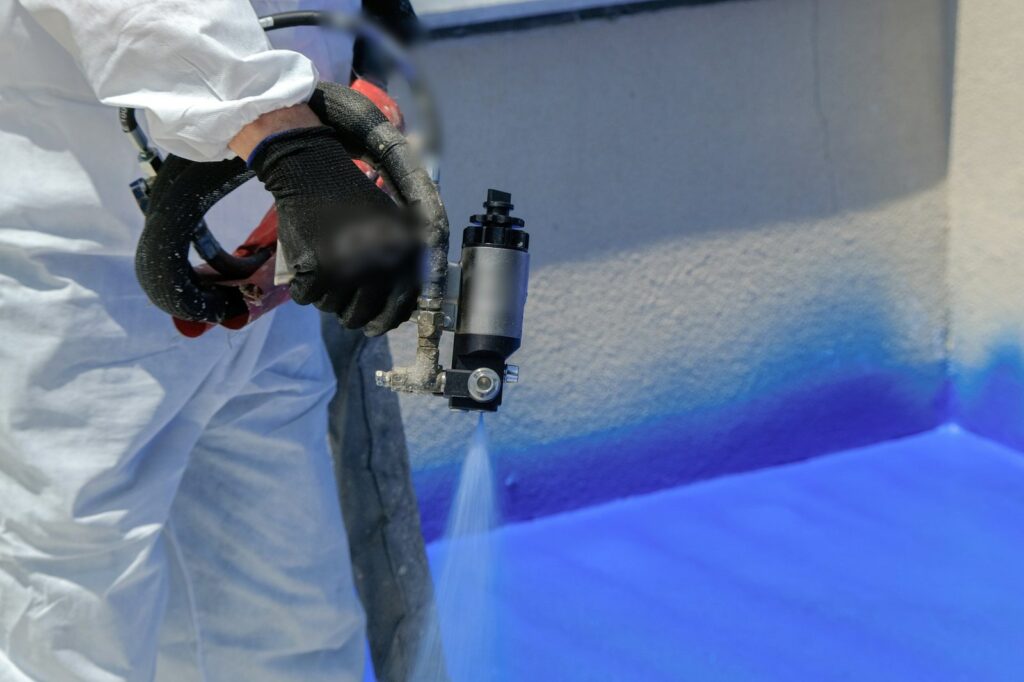
Polyurea is a family of elastomeric coatings and linings that cure in seconds rather than hours. That speed is the reason it is used on tank interiors, secondary containment, bridge decks, parking structures, roofs and concrete that has to go back into service quickly. It is also the reason polyurea is unforgiving: the material has very little time to wet out a surface, and it needs specialized equipment and trained applicators.
This guide explains what polyurea is chemically, how it is applied, where it works well, where it causes problems and how it compares with polyurethane. It is general information. The coating system for a real structure should be specified by a qualified engineer or coatings specialist working from the manufacturer’s data sheets and the standards that apply to the project.
Key takeaways
- Polyurea is defined by its chemistry, not by a brand: isocyanate reacting with amines produces urea linkages.
- “Pure” and “hybrid” polyurea behave differently. Hybrids include polyols in the resin blend, which changes cure, moisture sensitivity and chemical resistance.
- Most polyurea is spray-applied with heated, high-pressure plural-component equipment that mixes the two components in the gun.
- Fast set is both the main advantage and the main risk. It allows quick return to service and thick vertical builds, but leaves little time to correct mistakes.
- Aromatic polyurea yellows and chalks in UV light; an aliphatic topcoat is the usual answer where appearance matters.
- Polyurea is not automatically better than polyurethane or epoxy. The right choice depends on exposure, substrate and schedule; see our comparison of protective coating systems.
The chemistry in plain terms
Polyurea is made from two liquid components that are kept apart until the moment of application.
- The A side is an isocyanate, usually a prepolymer or quasi-prepolymer based on an aromatic isocyanate such as MDI, or an aliphatic isocyanate for light-stable grades.
- The B side is a resin blend made mostly of amine-terminated polyether resins plus amine chain extenders, with pigments and additives.
When the two meet, the isocyanate groups react with the amine groups to form urea linkages. The reaction is very fast and does not need a catalyst. The result is a tough, flexible polymer whose properties (hardness, elongation, tensile strength, tear resistance) are tuned by the choice of resins and the ratio of soft and hard segments in the polymer chain.
Polyurethane is made the same basic way, but the B side is a polyol (hydroxyl groups instead of amine groups). The isocyanate–polyol reaction is slower and usually needs a catalyst. That one difference in the B side explains most of the practical differences between the two materials.
Why moisture behaves differently
Isocyanates also react with water, producing carbon dioxide. In a slow-curing polyurethane, humidity or damp surfaces can therefore cause bubbles, foaming and pinholes. In polyurea, the isocyanate–amine reaction is so much faster than the isocyanate–water reaction that the material is far less sensitive to humidity while it cures.
This is often summarized as “polyurea can be applied in any weather”. That is an oversimplification. Low sensitivity to air humidity does not make polyurea tolerant of wet or damp substrates. Water on or in the surface still undermines adhesion, and moisture vapor or air escaping from concrete still causes blisters and pinholes. Manufacturers state limits for substrate moisture, surface temperature and the margin above dew point, and those limits apply.
Pure vs hybrid polyurea
Terminology varies between suppliers, so read the data sheet rather than relying on the label.
| Type | B side resin blend | General behavior | Typical considerations |
|---|---|---|---|
| Pure (aromatic) polyurea | Amine-terminated resins and amine extenders only | Fastest cure, low humidity sensitivity, good chemical resistance for an elastomer | Yellows and chalks in sunlight; needs heated plural-component equipment |
| Pure aliphatic polyurea | Aliphatic isocyanate with amine-terminated resins | Light-stable color and gloss | Higher material cost; often used as a topcoat rather than full thickness |
| Hybrid (polyurea/polyurethane) | Blend of amines and polyols | Cure and properties sit between polyurea and polyurethane | More sensitive to moisture and temperature; chemical and thermal resistance usually lower than pure grades |
| Polyaspartic | A specific class of aliphatic amine (aspartic ester) reacting with aliphatic isocyanate | Slower than spray polyurea, can be rolled or brushed, light-stable | Common in floor and topcoat systems; pot life and cure vary widely by product |
Hybrids are not inferior by definition. They are often cheaper and can be suitable for less demanding service. The problem is when a hybrid is supplied for an immersion or chemical exposure that was specified with a pure polyurea in mind. If the specification depends on chemical resistance, name the chemistry required and ask for test data relevant to the actual exposure.
How polyurea is applied
Spray polyurea is applied with a plural-component system. A typical rig includes:
- Transfer pumps that feed the A and B components from drums, plus a mixer for the B side, which can settle.
- A proportioner that meters both components, most commonly at a 1:1 volume ratio, and pumps them at high pressure. Operating pressures are typically in the thousands of psi (often somewhere in the range of roughly 2,000 to 3,500 psi, or about 140 to 240 bar), set according to the material data sheet.
- Heaters and heated hoses that bring both components to the temperature the manufacturer specifies, which lowers viscosity so the components mix properly.
- An impingement mixing spray gun, where the two streams collide at high pressure in a small chamber and leave the tip already reacting.
- Air dryers or desiccant systems on the isocyanate side, because isocyanate reacts with moisture in the air and can crystallize.
Most rigs are mounted in a trailer or truck with a generator and compressor. Equipment cost, maintenance and operator training are a real part of the price of a polyurea job and a reason some smaller projects use slower hand-applied systems instead.
Typical film thickness depends on the application. Many concrete and steel protection systems are built in the range of roughly 1 to 3 mm (about 40 to 120 mils), with some linings and waterproofing membranes thicker. Treat these as general ranges only; the specification and the manufacturer’s data sheet set the actual minimum thickness.
Quality control during spraying
Because the material sets so quickly, quality control happens at the rig as much as on the surface:
- Monitoring and recording pressures and temperatures on both sides; an imbalance changes the mix ratio.
- Spraying test patches or test panels at the start of each shift and checking hardness, cure and appearance.
- Measuring wet or dry thickness as work progresses, and on concrete by destructive or ultrasonic methods as the specification allows.
- Recording substrate temperature, air temperature, relative humidity and dew point.
- Respecting recoat windows. If a coat has cured beyond the manufacturer’s recoat time, the surface usually needs abrading or a bonding primer before the next coat.
Our guide to coating inspection basics covers these checks within the wider inspection process.
Fast set: advantages and drawbacks
| Advantage | Drawback |
|---|---|
| Return to service in hours rather than days, which matters for tanks, bridges and parking decks | Very short time to wet out the substrate, so penetration into concrete pores is minimal and a primer is usually needed |
| Thick films in multiple passes in one session, including on vertical and overhead surfaces without sagging | Little or no self-leveling; gun technique shows in the finish |
| Wide range of application temperatures | Mistakes are cured within seconds and must be cut out and repaired |
| Low sensitivity to humidity during cure | Overspray travels and sets on whatever it lands on; masking and wind control are essential |
| Continuous membrane without laps or seams | Recoat windows can be short; intercoat adhesion needs planning on large jobs |
Where polyurea is used
- Secondary containment around tanks and process areas, where a continuous, crack-bridging lining is useful.
- Water and wastewater structures, including tanks, channels, manholes and wet wells, with chemistry and certification checked for the exposure; see our guide to wastewater tank linings.
- Concrete protection against water, chlorides and carbonation, and as high-elongation membranes in anti-spalling systems; see concrete spalling prevention.
- Bridge deck and parking deck waterproofing, under asphalt or as an exposed traffic membrane; see bridge deck waterproofing.
- Below-grade waterproofing of walls and slabs, and some tunnel applications; see below-grade waterproofing.
- Roofing, including as a protective layer over spray foam.
- Steel protection, such as pipe, structural steel and equipment, usually over a suitable primer.
- Industrial flooring and truck bed liners, where abrasion and impact resistance matter.
Limitations to understand
Surface preparation sensitivity. Polyurea relies on mechanical and chemical adhesion to a clean, sound, profiled surface. On concrete, that means removing laitance, curing compounds, oil and weak material, usually by shot blasting, grinding or abrasive blasting to the concrete surface profile (ICRI CSP 1 to 10 scale) the manufacturer requires, then priming. On steel, abrasive blasting to a specified cleanliness and profile under AMPP (formerly SSPC and NACE) or ISO standards is typical.
Outgassing and pinholes on concrete. Concrete contains air and moisture in its pores. When the slab warms, air expands and escapes through the fresh coating, leaving pinholes or blisters. Common mitigations are a penetrating primer or a sealing coat, and applying when the concrete temperature is stable or falling rather than rising. Pinholes matter most in linings, where every one is a potential path for the stored liquid.
UV and color. Aromatic polyurea darkens, yellows and chalks under sunlight. The change is largely cosmetic at first, but surface degradation continues over time. Exposed work where color, gloss or long-term surface condition matters usually gets an aliphatic polyurea, polyaspartic or aliphatic polyurethane topcoat. Our guides to aromatic vs aliphatic coatings and liquid-applied roof waterproofing cover topcoats and long-term UV exposure in more detail.
Chemical resistance is not universal. Polyurea handles water, many salts and dilute chemicals, but concentrated acids, some solvents and elevated temperatures can attack it. Check the manufacturer’s chemical resistance data for the actual chemicals, concentrations and temperatures, and ask for immersion test data where the exposure is severe.
Equipment and skill. A poorly maintained rig or an inexperienced operator can produce off-ratio material that looks fine and fails later. Ask about applicator training, rig maintenance and how off-ratio material is detected.
Health and safety. Isocyanates are respiratory and skin sensitizers. Spray application requires appropriate respiratory protection (often supplied air), skin protection, ventilation, and control of access to the spray zone. Follow the safety data sheet and the occupational health rules where the work takes place.
Repairs. Damaged polyurea can be repaired, but the cured surface usually needs abrading and a manufacturer-approved bonding primer. Repairs on old linings in service may need more work than the original application.
Polyurea vs polyurethane
| Factor | Polyurea | Polyurethane |
|---|---|---|
| Reaction | Isocyanate + amine | Isocyanate + polyol (usually catalyzed) |
| Cure speed | Seconds to gel; very fast return to service | Minutes to hours; depends on product and temperature |
| Humidity sensitivity during cure | Low | Higher; moisture can cause bubbles or foaming |
| Application | Mostly heated plural-component spray | Spray, roller, squeegee or trowel, depending on product |
| Wetting of substrate | Limited; primer usually required on concrete | Better; slower products can wet out and level |
| Detailing by hand | Difficult; spray-applied | Easier; hand-applied grades available |
| Equipment cost | High | Low to high depending on method |
| UV stability | Aromatic grades discolor; aliphatic grades available | Aromatic grades discolor; aliphatic grades widely used as topcoats |
Both are broad families. A high-performance polyurethane membrane can outperform a poor polyurea, and the reverse. Many systems combine them, for example a polyurea membrane with an aliphatic polyurethane topcoat, or a hand-applied polyurethane used for details on a sprayed polyurea job.
What to ask before choosing polyurea
- What exposure must the coating resist: water, chlorides, chemicals (name them), temperature, abrasion, UV?
- Is the material pure polyurea, a hybrid or another chemistry, and does the data sheet support the intended service?
- What primer, surface profile and moisture limits does the manufacturer require for this substrate?
- What minimum dry film thickness is specified, and how will it be measured?
- How will pinholes and holidays be found and repaired?
- What are the recoat windows, and how will intercoat adhesion be handled on large areas?
- Does the applicator have documented training on this material and equipment?
- Are any certifications required, such as NSF/ANSI/CAN 61 for contact with drinking water in North America?
Bottom line
Polyurea is a fast-curing, elastomeric coating formed by an isocyanate–amine reaction. It is valuable where downtime is expensive, where cracks need bridging and where a continuous membrane without laps is needed in one visit. It is not a shortcut around preparation: the speed that makes it attractive also gives it little tolerance for contaminated, damp or poorly profiled surfaces. Choose it for the exposure and schedule it suits, insist on the manufacturer’s preparation and thickness requirements, and have the system specified by people qualified to do so.