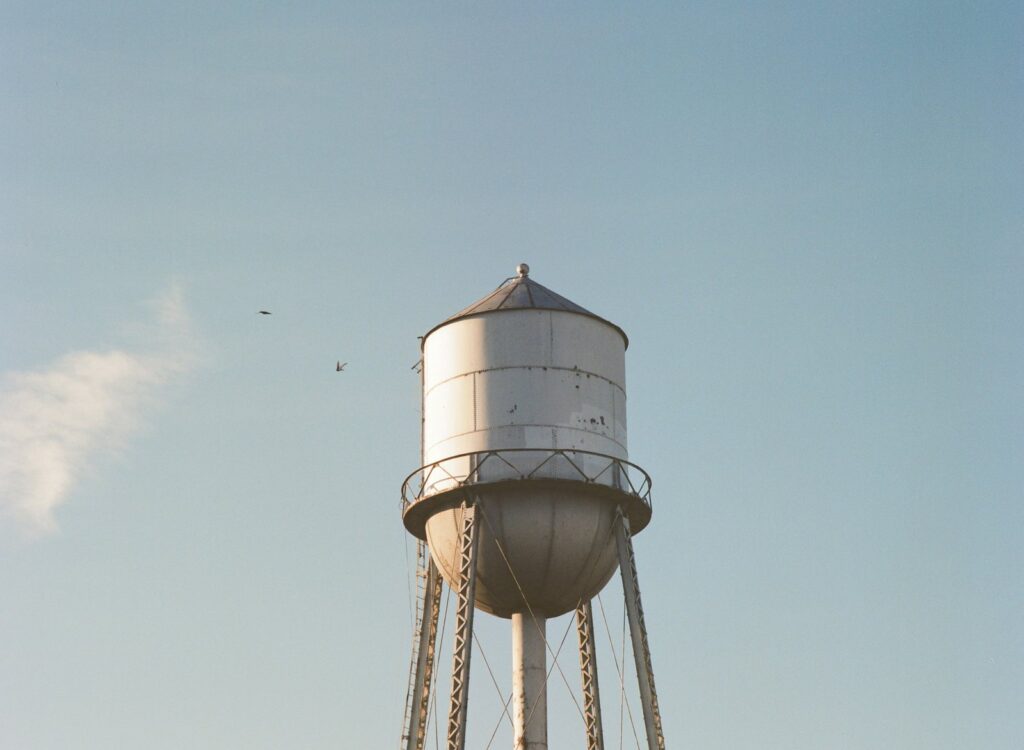
A coating inside a drinking water tank has two jobs. It must protect the steel or concrete from corrosion and deterioration for many years, and it must do that without adding anything harmful, or anything that affects taste and odor, to water people drink. The second job is what makes potable water linings a separate category from industrial tank linings and wastewater linings.
This guide explains how drinking water linings are certified, what the certification does and does not cover, how steel and concrete tanks differ, why cure and ventilation matter so much, and how a tank returns to service. It is general information for owners, utility staff and students. A real lining project needs a specification from a qualified engineer or coatings specialist, products certified for the intended use, the manufacturer’s data sheets and the requirements of the water authority and applicable standards.
Key takeaways
- In North America, materials in contact with drinking water are commonly required to be certified to NSF/ANSI/CAN 61. Other countries have their own approval schemes.
- A listing sets conditions: maximum thickness or number of coats, cure time and temperature, and often minimum tank volume and water temperature.
- Steel tanks usually need abrasive blast cleaning, stripe coating of edges and welds, and attention to the roof and vapor space, where corrosion is often worst.
- Concrete tanks need sound, clean, profiled concrete with moisture and outgassing under control, and a lining that can cope with cracks and joints.
- Ventilation during cure, inspection, disinfection and water quality testing come before the tank is put back into service.
Why drinking water linings are different
Any material in contact with water can release small amounts of substances into it. For drinking water, regulators are concerned with:
- Health effects: organic compounds such as residual solvents and unreacted components, and metals or other substances from pigments and fillers.
- Taste and odor: even low concentrations of some compounds can cause complaints.
- Microbial growth: some materials can support biofilm growth more than others.
- Interaction with disinfectants: linings are exposed to chlorine or chloramine residuals throughout their life.
Industrial and wastewater linings are not evaluated for these effects. A lining that performs well in a sewer wet well, as described in wastewater tank and wet well linings, should never be used in a drinking water tank unless it also carries the required certification for that use.
Certification and approval schemes
North America
NSF/ANSI/CAN 61 is the standard most commonly used to evaluate the health effects of drinking water system components, including coatings and linings. Products are tested and certified by accredited certification bodies, and the certified products are listed publicly. Many states, provinces and utilities require certification to it, and plumbing and water codes often reference it. A related standard, NSF/ANSI/CAN 600, sets out the health-based evaluation criteria used in the assessment.
Elsewhere
Many countries operate their own approval systems. In the UK, products for use in public water supply are approved under a scheme overseen by the Drinking Water Inspectorate. Several European countries run national testing and approval schemes, and other countries have their own requirements or accept certain foreign certifications. The water authority or regulator decides which approval applies to a specific tank.
What a listing actually says
Certification does not mean a product is approved for any potable use in any way. A listing typically states:
| Listing element | Why it matters |
|---|---|
| Exact product name and components | Similar-sounding products may not be certified |
| Maximum film thickness or number of coats | More material can mean more substances released |
| Cure schedule (time at a stated temperature) before contact with water | Releases fall as the coating cures |
| Minimum tank size or volume | Ratio of coated surface to water volume affects concentration |
| Water temperature (cold or hot) | Higher temperatures can increase releases |
| Intended use (tanks, pipes, fittings) | A tank listing does not cover all applications |
The specification should require the contractor to submit the current listing for the exact product, and the inspector should check that the thickness, cure and tank size on the job fall within it. Data sheets can be out of date, and listings change.
Steel tanks
Welded and bolted steel tanks, standpipes and water towers are common in water systems. Corrosion conditions vary by zone:
| Zone | Exposure | Typical concerns |
|---|---|---|
| Interior wet (submerged) | Continuous immersion in treated water | Pinholes, edge corrosion, blistering, disinfectant exposure |
| Interior dry (roof and upper shell) | Condensation, warm humid air, chlorine off-gassing | Often the most aggressive interior zone; difficult geometry under roof framing |
| Exterior | Atmosphere, UV, coastal or industrial pollution | Appearance, corrosion at welds and fasteners |
Preparation
Interior immersion linings on steel typically require abrasive blast cleaning to a high cleanliness grade under AMPP (formerly SSPC and NACE) or ISO 8501 grading, with a surface profile matching the coating manufacturer’s requirements. Soluble salts on blasted steel can cause blistering under immersion, so many specifications include salt testing and limits. Weld spatter, sharp edges and laminations are removed or rounded before coating, and crevices such as roof lap seams and rafter connections may be sealed with a suitable certified sealant. Our guide to blast cleaning steel before coating explains cleanliness grades, profile and salt testing in more detail.
Coating systems
Multi-coat epoxy systems are widely used for interior wet surfaces. Some systems use a zinc-rich primer under epoxy, and 100% solids epoxies, polyurethanes and polyureas are used where they carry the required certification. Exterior systems on steel tanks are separate and need not be potable-certified, but overspray and runoff must not reach the interior. In North America, AWWA publishes standards for coating steel water storage tanks, and many utilities base their specifications on them.
Stripe coats and details
Edges, welds, bolts, ladders, brackets and pipe penetrations are where interior linings usually fail first. Stripe coats, brushed onto these details before or between full coats, help achieve full thickness there. Some steel tanks also have cathodic protection for submerged surfaces, which works alongside the lining.
Old coatings
Older tanks may have coatings containing lead, chromates or coal tar products. Testing old coatings before removal is standard practice because it determines containment, worker protection and waste disposal requirements under local regulations.
Concrete tanks
Cast-in-place, precast and prestressed concrete tanks and reservoirs are also widely used. Concrete is generally durable in contact with treated water, but linings may be needed where:
- Soft or aggressive water leaches the cement paste and erodes the surface.
- Cracks or joints leak.
- The surface has deteriorated, for example through freeze-thaw near the water line.
- The owner wants a smooth, cleanable surface.
Options include certified cementitious coatings and mortars, certified epoxies, and certified elastomeric linings where crack bridging is needed. Joints and cracks need a decision on movement: rigid linings crack over moving joints, so joints are usually detailed separately with certified sealants or flexible strips.
Preparation follows the same principles as other coatings on concrete: remove laitance, contamination and weak material, achieve the profile the manufacturer requires and control moisture and outgassing. Our guide to concrete surface preparation and CSP profiles explains those steps. Concrete tanks are rarely dry, so moisture-tolerant primers or cementitious resurfacing layers are often part of the system.
Cure, ventilation and return to service
Ventilation during application and cure
Solvent-borne coatings release solvent vapor as they cure. In a closed tank, vapor can build up to levels that are unsafe for workers and that slow the cure. Forced ventilation, often with dehumidification and sometimes heating, is used to keep vapor concentrations down, keep the steel above the dew point margin the manufacturer requires and maintain the temperature that the cure schedule assumes.
Cure before filling
The certification listing and the data sheet state a minimum cure time at a stated temperature before the lining contacts water. At lower temperatures, cure takes longer, sometimes much longer. Filling too early can leave the lining soft, cause blistering and increase the release of substances into the water, which can lead to taste and odor complaints or failed water quality tests. Some specifications require a cure test on the lining before filling, using a method agreed with the manufacturer.
Inspection before filling
Before release, the inspector typically confirms dry film thickness, the absence of holidays, cure and visual condition, and that all repairs are complete. Immersion linings are usually holiday tested; see holiday testing explained. Our guide to coating inspection basics covers the wider set of checks.
Disinfection and water quality testing
After cleaning, the tank is disinfected according to the water authority’s procedures. In North America, AWWA publishes a standard for disinfecting water storage facilities that many utilities follow. After filling, water samples are tested for bacteriological quality and sometimes for taste, odor or specific organic compounds before the tank is released to supply. Only the water authority decides when the tank goes back into service.
Safety
Tank interiors are confined spaces with limited exits, poor ventilation and often work at height. Coating work adds flammable and toxic vapors, isocyanates in some systems, and blasting dust. Work requires confined space entry procedures, gas monitoring, ventilation, fall protection, rescue planning and respiratory protection in line with the safety data sheets and local regulations.
Questions owners should ask
- Is the proposed product certified for drinking water contact under the scheme our regulator requires, and can we see the current listing?
- Do the proposed thickness, number of coats, tank size and cure conditions fall within the listing?
- How will cure be confirmed before filling, especially in cold weather?
- What surface preparation, cleanliness and soluble salt limits apply?
- How will edges, welds, roof framing and joints be detailed?
- What inspection, holiday testing and documentation will be provided?
- What disinfection and water quality testing will be done before return to service?
- Have existing coatings been tested for lead or other hazardous materials?
Bottom line
Lining a drinking water tank combines ordinary protective coating work with health requirements. Use only products certified for potable water contact under the applicable scheme, and keep thickness, tank size and cure within the conditions of the listing. Prepare steel and concrete to the manufacturer’s requirements, pay special attention to the roof zone, welds and joints, ventilate and cure fully, then inspect, disinfect and test the water before the tank returns to service. The specification belongs to qualified engineers working with manufacturers’ data, the certifier’s listings and the applicable standards.