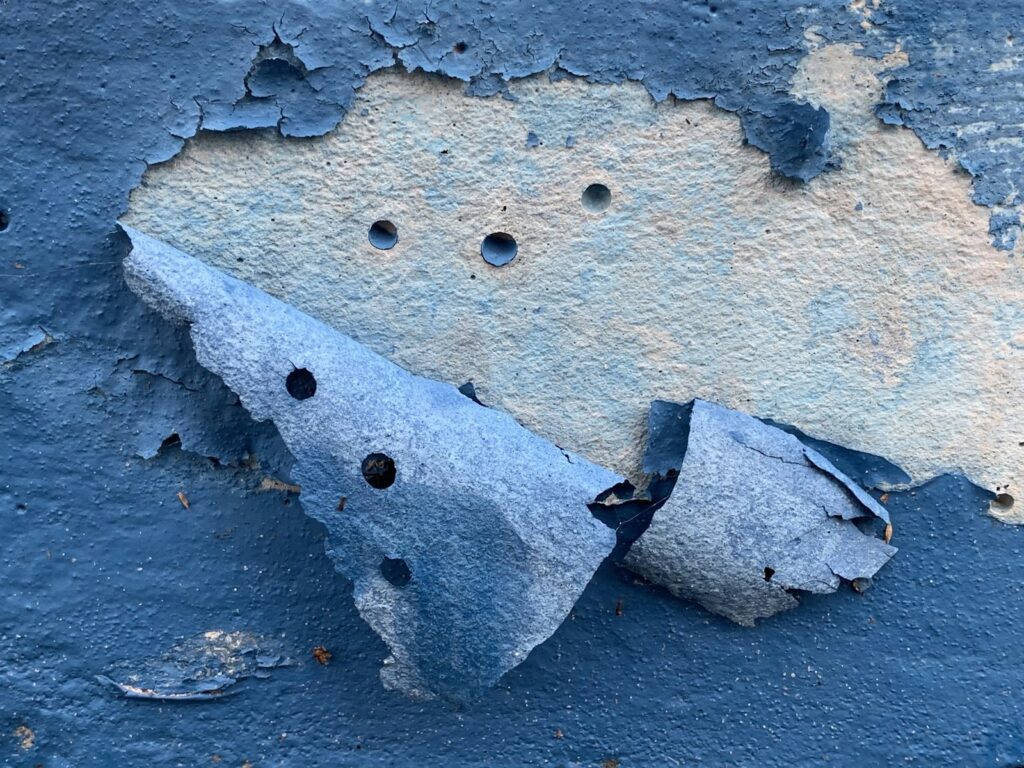
When a coating fails, the first question is usually who pays. The more useful question is why it failed, because the answer decides whether a repair will last or fail the same way. Recoating a blistered lining without knowing that the blisters came from salt contamination or a damp slab is one of the most expensive mistakes in protective coatings.
Most failures fall into a small number of patterns, and each pattern has a short list of likely causes. This guide describes the common ones on concrete and steel, what an inspection looks for, and how the cause is usually confirmed. It is general information for owners, contractors and students, not a substitute for a failure investigation. Diagnosis and remedial specifications for a real structure come from a qualified engineer or coatings specialist, working with the manufacturer’s data sheets and the applicable standards.
Key takeaways
- Blisters usually come from moisture or soluble contamination under the film, or from solvent or gas trapped inside it.
- Pinholes on concrete are most often caused by outgassing as the substrate warms during application.
- Delamination is usually a surface problem: contamination, poor profile, weak concrete, missed recoat windows or amine blush.
- Cracking points to excessive thickness, substrate movement or an unsuitable rigid system.
- Underfilm corrosion and rust at edges usually trace back to preparation, salts, thin film or poor edge coverage.
- Confirming the cause needs records, field tests and sometimes laboratory analysis.
Failure patterns at a glance
| Defect | What it looks like | Likely causes | What to check |
|---|---|---|---|
| Osmotic blisters | Dome-shaped blisters, often liquid-filled, sometimes acidic or alkaline | Soluble salts on steel; moisture and soluble material at the bond line on concrete; immersion service | Salt test records, moisture records, blister fluid pH, substrate under the blister |
| Solvent entrapment blisters | Small blisters, film soft underneath | Thick coats, short recoat times, cold conditions | DFT, recoat times, temperatures |
| Outgassing pinholes | Pinholes and craters, often in lines along pores or bugholes | Air and vapor leaving the concrete as it warms | Time of application, substrate temperature trend, pore filling |
| Delamination from substrate | Coating peels clean from concrete or steel | Contamination, low profile, laitance, curing compound, dust, moisture | Underside of the peeled coat, profile, preparation records |
| Cohesive failure in concrete | Coating comes off with a thin layer of concrete attached | Weak surface, bruising from preparation, carbonated or friable concrete | Pull-off failure mode, surface strength |
| Intercoat delamination | Topcoat peels from the coat below | Recoat window exceeded, amine blush, contamination, incompatible products | Recoat times, blush records, product approvals |
| Cracking and checking | Fine or wide cracks in the film | Excess DFT, substrate cracks moving, rigid coating over moving cracks, embrittlement | DFT, crack mapping, system flexibility |
| Underfilm corrosion | Rust creeping under the film from a defect or edge | Thin film, holidays, salts, poor edge preparation | Edge condition, DFT, holiday records |
| Chalking and erosion | Powdery surface, color fading | UV degradation of aromatic resins | Topcoat presence, chalk rating, remaining DFT |
Blisters
Osmotic blistering
A coating is a semi-permeable membrane. Water vapor passes through it slowly. If there is something soluble under the film, such as chloride salts on steel or soluble material on concrete, water is drawn toward it by osmosis and builds pressure. The coating lifts in blisters. In immersion and buried service this can happen quickly.
On steel, the usual root cause is salts not removed during preparation. Our guide to blast cleaning steel before coating explains salt testing and removal. On concrete, moisture moving up through the slab combined with alkaline or soluble material at the bond line produces a similar effect; see testing concrete moisture before coating.
Cathodic disbondment
On buried or immersed steel with cathodic protection, alkali forms at the steel surface at coating defects and can push the coating off around the defect. The coating needs to be qualified for the cathodic protection conditions; manufacturers test for this.
Solvent and gas entrapment
Thick solvent-borne coats, or coats applied before the one below has released its solvent, can trap solvent. As it escapes later, it forms small blisters or a soft film. Cold weather and short recoat intervals make it worse.
Rating blisters
ISO 4628-2 and ASTM D714 give reference images for describing blister size and density. Using them makes inspection reports comparable over time.
Pinholes and outgassing
Concrete contains air in its pores and bugholes. When the concrete warms, the air expands and moves out through the surface. If it passes through a fresh coating that is still wet, it leaves pinholes or small craters. These may look minor but they can go through the film, which matters for linings and waterproofing.
Typical causes and controls:
- Applying on a rising temperature, such as on a sunny morning or in a tank as the day warms. Application on a steady or falling substrate temperature is a common rule of thumb.
- Open surface pores and bugholes. Filling with a resurfacer or pore filler and applying a penetrating primer reduce outgassing. See concrete surface preparation and CSP profiles.
- Fast-setting products that seal over before gas escapes. Some systems use a scratch coat or more primer coats.
- Air entrained in the coating by mixing or by rollers, or solvent popping in hot conditions.
On linings, pinholes are found by holiday testing, repaired and retested.
Delamination
Delamination is a loss of adhesion. The key diagnostic is the plane of failure, which shows on the back of a removed piece and in pull-off test results.
From the substrate
- On concrete: laitance, curing compounds, sealers, oil, dust, inadequate profile or moisture. If the back of the coating is clean and smooth, it never bonded properly.
- On steel: mill scale, rust, oil, dust, low profile, flash rust or condensation on the surface during application.
Within the concrete
If the coating comes off with a skin of concrete attached, the coating bonded but the concrete beneath was weak. Causes include weak surface paste, bruising from aggressive preparation, carbonated or deteriorated concrete, or freeze-thaw damage. Pull-off tests on the prepared surface before coating would usually have shown this.
Between coats
- Recoat window exceeded. Many coatings cure to a hard, chemically resistant surface that the next coat cannot bond to without abrading or a tie coat.
- Amine blush on epoxies applied in cool, humid conditions.
- Contamination between coats: dust, overspray, chalk, condensation or residue from holiday testing wetting agents.
- Incompatible products, especially when coats come from different manufacturers without approval.
Cracking
- Mud cracking and checking in thick, rigid films, often from excessive dry film thickness. Inspection records showing high DFT readings support this.
- Reflective cracking where a rigid coating sits over a moving crack in the concrete. The crack in the coating follows the crack below. Crack-bridging, elastomeric systems are used where movement is expected, which is a decision to make at the design stage rather than after the first cracks appear.
- Embrittlement of exposed elastomers after long UV exposure, especially without a topcoat; see aromatic vs aliphatic coatings.
Corrosion under and around the film
On steel, corrosion that starts at edges, welds, bolts and damage then creeps under the film is a common pattern. Causes include thin film at sharp edges, no stripe coat, salts left on the steel, holidays and mechanical damage. ISO 4628-3 and ASTM D610 provide ways to rate the degree of rusting, which helps when deciding between spot repair and full recoating.
How a failure is investigated
A structured investigation usually follows these steps:
- Collect records. Specification, data sheets, batch numbers, preparation and ambient records, DFT and test results. Gaps in records are themselves information. The records described in coating inspection basics are the starting point.
- Survey the extent. Map where the failure occurs and where it does not. Patterns by orientation, time of application, area or coat are strong clues.
- Field tests. DFT, adhesion tests with failure mode, blister fluid pH, salt tests on exposed substrate, moisture tests on concrete.
- Samples. Cut samples that include all coats and, where possible, substrate. Photograph and label them.
- Laboratory analysis where needed: cross-sections under a microscope to see each coat and the failure plane, and chemical analysis of contamination or of the coating itself.
- Conclusion and remedy. Identify the cause, then write a repair that removes it.
Owners should ask who is doing the investigation and whether they are independent of the parties involved.
Avoiding a repeat
- Specify preparation, moisture and salt limits clearly and inspect them at hold points.
- Plan application timing around temperature, dew point and outgassing.
- Keep to recoat windows and check for blush and contamination between coats.
- Control thickness with wet film checks during application and DFT checks afterwards.
- Choose systems that suit movement and exposure, including topcoats where UV is present.
- Record everything, so the next diagnosis does not start from guesswork.
Frequently asked questions
Can blisters just be cut out and patched? Small, isolated blisters sometimes can, once the cause is known. Widespread blistering usually means the cause is general, and patches will be surrounded by new blisters.
Is a failure always the applicator’s fault? No. Specification, product selection, substrate condition, design and service conditions all contribute. That is why an investigation looks at all of them.
How soon do failures appear? Some show within days, such as pinholes and poor cure. Osmotic blistering may take months. UV and corrosion-related failures can take years.
Bottom line
Coating failures usually follow recognizable patterns: blisters from moisture, salts or trapped solvent; pinholes from outgassing; delamination from contamination, weak substrates or missed recoat windows; cracking from thickness or movement; and corrosion from poor edges and thin film. The plane of failure, the records and a few targeted tests usually point to the cause, and the repair must remove that cause. Diagnosis and remedial specifications come from qualified engineers, the manufacturer’s data sheets and the applicable standards.